
How to write a business plan
AI has changed how business plans get written. This guide doesn't recite theory at you: it gives you ready-to-use prompts, mini-tools that do the maths and a method for testing your plan against reality.
Updated July 2026.
Free, no credit card required.
Three resources, zero filler
Each one is built to be used, not just read. Start with whichever you're missing today.
AI prompt library
Twelve professional prompts (market research, business model, assumptions, pitch), ready to paste into the AI of your choice.
Break-even calculator
Your numbers, a live calculation, one clear answer: how much do you need to sell to stop losing money?
Business models by sector
How money comes in across your industry: the models that work, their traps, and where to start.
The 5 steps to a business plan that holds up
There's no secret to the method. What changes everything is following it all the way through, especially after launch.
Nearly 1 in 3 French companies founded in 2018 were gone before their fifth birthday, proof that a business plan doesn't run itself.
(Source: Insee, 2025)
-
Nail down your business model
Before you build a single table, answer four questions: who has the problem, what are you selling, who pays, and how the money comes in (per unit, by subscription, on commission). If the answer doesn't fit in three sentences, the rest of the plan will only dress up the fog.
With BeretPlan: start from one of the app's generic templates (SaaS, e-commerce, services) instead of a blank page.
Explore business models by sector -
Put numbers on your assumptions
A business plan isn't a prediction: it's a list of assumptions you're willing to own. A price, a volume, a conversion rate, your costs. Write them down, one by one: they are what your banker will challenge, not your layout.
With BeretPlan: every assumption becomes a named variable. Change it once and the whole plan updates.
Prepare your assumptions with the AI prompts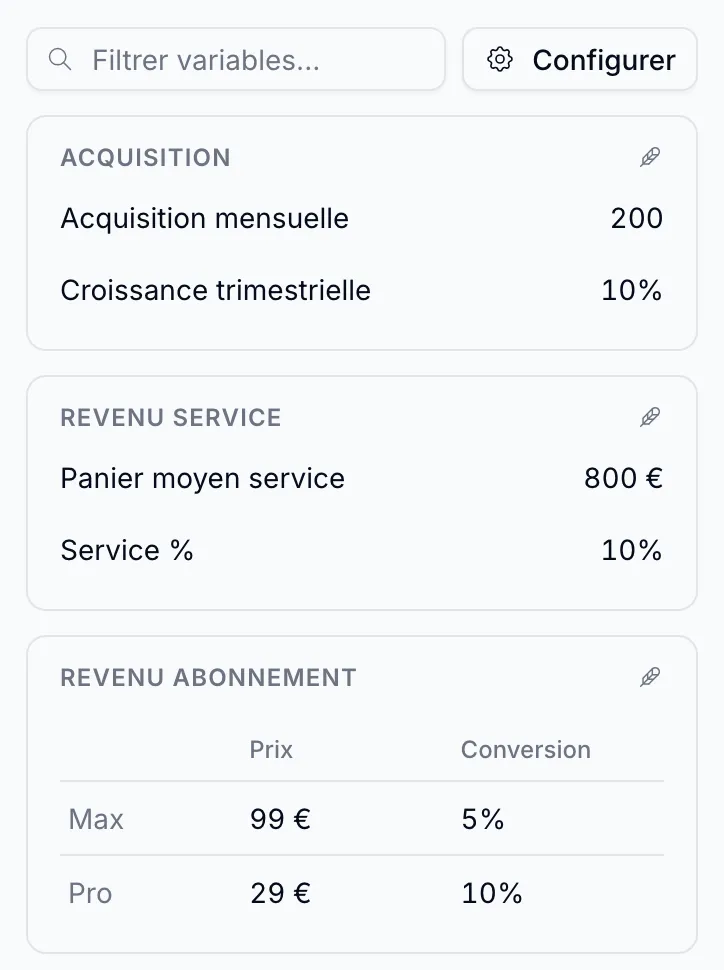
-
Build the forecast
Sales, costs and profit, month by month, over two to three years. The goal isn't precision (nobody can predict month 27), it's consistency: revenue must flow from your assumptions, never the other way round. First thing to check: the month you stop losing money.
With BeretPlan: the income statement and the dashboards are generated from your plan, with formulas you can actually read, and no #REF!.
Calculate your break-even point -
Test the plan against reality
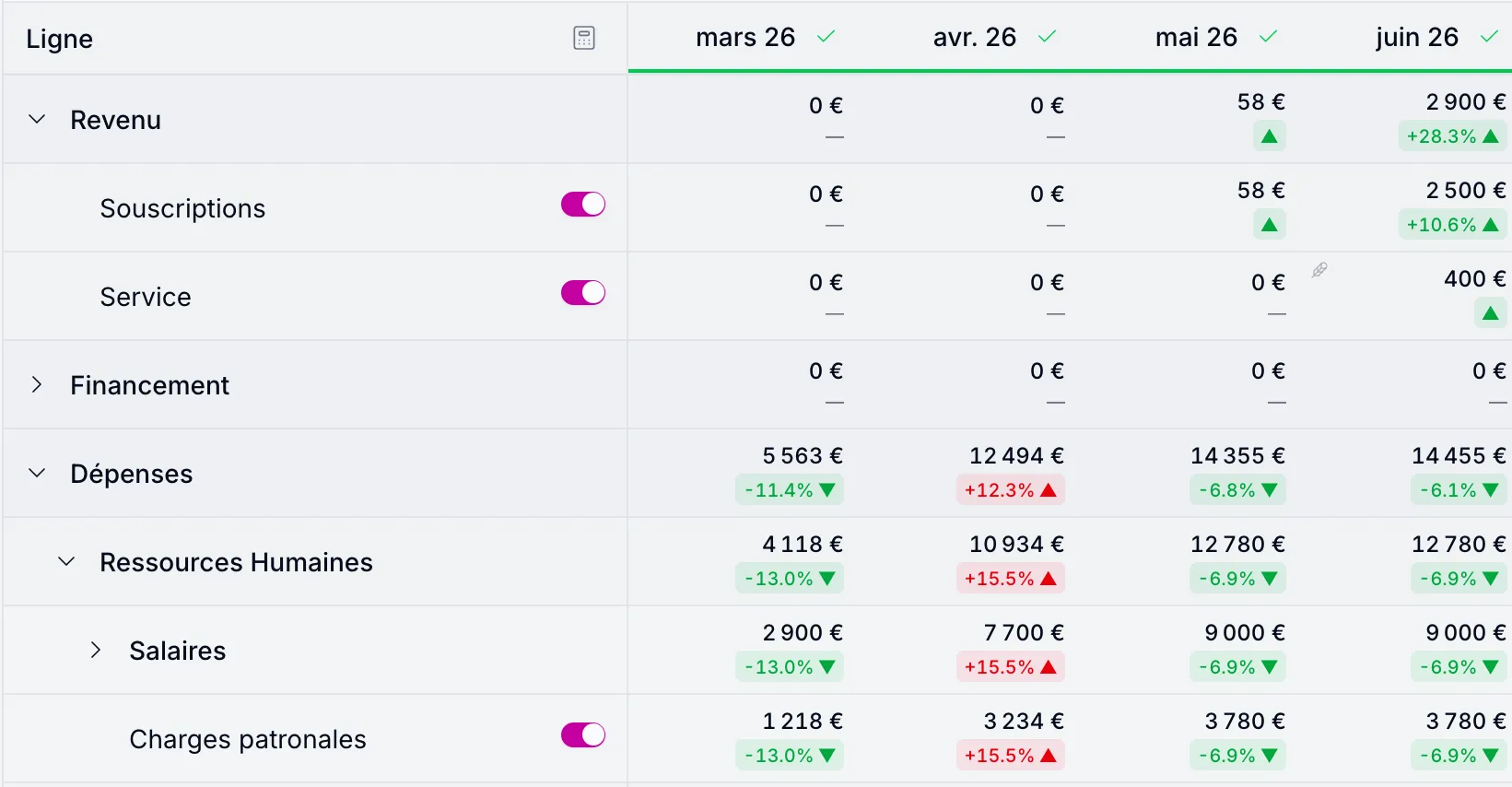
The step almost everyone skips, and the one that turns a document into a tool. Every month, enter what actually happened and look the variances in the eye. A variance isn't a mistake: it's information, and it's worth a lot.
With BeretPlan: actuals are entered line by line against the forecast, and variances are coloured by their real impact. An expense drifting off course stands out, even while the curve is going up.
-
Iterate
Reality is always right. When a price turns out too low or a channel doesn't deliver, update the assumption, not the story around it. A living business plan gets rewritten; that's precisely how you know it's earning its keep.
With BeretPlan: change one variable and the forecast, the income statement and the dashboards all recalculate. No more “final_v3_REAL.xlsx”.
Soon Alternative scenarios, by the end of the year: compare several versions of your plan (“what if I hired earlier?”) without duplicating it.

A plan that holds up is a plan you steer.
Set your assumptions and get a forecast that recalculates itself: a complete budget in under 2 hours.
Free, no credit card required