Not three-line “act as an expert” snippets: complete prompts (context, constraints, output format) for the AI of your choice. Copy, replace the [brackets], move on.
Updated July 2026.
Be specific inside the [brackets]
Industry, city, price, target customer: the more concrete your context, the more usable the answer. Vague in, vague out.
Demand sources
Every prompt tells the AI to separate facts from assumptions. Verify any figure that matters before it goes into your plan: an AI that doesn't know will make something up.
Chain the steps
Stay in the same conversation: the market research feeds the business model, the model feeds the assumptions, the assumptions feed the pitch.
Step 1: Market research
First, understand the terrain
Market, competitors, customers: three prompts to check that the problem exists before you put numbers on it.
Prompt 01
Frame your market, minus the jargon
To replace the copy-pasted TAM/SAM/SOM slide with an estimate you can actually defend.
                  You are a senior market analyst. You reason transparently and always distinguish sourced facts from estimates.

My project: [describe your product or service in 2-3 sentences].
My target customers: [who you're selling to].
My territory: [city, region, whole country…].

Your mission:
1. Estimate the size of my market from the bottom up (number of potential customers × plausible annual spend), not from the top down.
2. For every number you use, state whether it comes from a public source (cite it) or from an assumption (flag it clearly).
3. Give three scenarios: conservative, central, ambitious.
4. Finish with the 3 most fragile assumptions in your estimate: the ones I should verify first.

Output format: a table (scenario / calculation / result), then the list of fragile assumptions. No introductory fluff.
If you are missing information you need to reason properly, ask me before answering.
Prompt 02
Map the competition
The question your banker will ask anyway: “and why not them?”
                  You are a strategy consultant, direct and factual.

My offer: [describe your offer].
My industry: [your industry].
My territory: [your geographic area].

Your mission:
1. Identify my direct and indirect competitors, including "doing nothing" or "doing it themselves" if that is a realistic alternative for my customers.
2. For each one: positioning, price range where known, strengths, weaknesses, and who they serve.
3. Flag what you don't know rather than inventing it: unsourced prices and market shares must be marked "to be verified".
4. Conclude with the gaps left open, and the two questions I should answer before choosing my positioning.

Output format: a comparison table, then an analysis of 5 lines maximum.
Prompt 03
Sketch your typical customer, then verify them
A persona that ends up as interview questions, not as a poster on the wall.
                  You are a qualitative research specialist. Your goal is not to please me but to help me verify that the problem exists.

My product or service: [description].
The problem I believe I am solving: [the problem].
The people who live with it, as far as I can tell: [your target customers].

Your mission:
1. Describe 2 to 3 plausible customer profiles: situation, buying trigger, current alternatives, available budget, likely objections.
2. For each profile, point out the least certain part of my description.
3. Write an interview guide of 10 open questions to validate (or invalidate) the problem: questions about their life today, never about my product.
4. Add the 3 answers that should worry me if I hear them often.

Output format: one card per profile, then the numbered interview guide.
Step 2: Business model
Decide how the money comes in
Revenue model, pricing, channels: the three choices that shape the entire forecast.
Prompt 04
Choose your revenue model
Subscription, commission, one-off sales? The answer depends on your case, not on fashion.
                  You are a serial entrepreneur turned advisor. You prefer boring models that collect cash to elegant models that burn it.

My offer: [description], sold to [your target customers], in the [your industry] sector.
How I plan to make money today: [subscription, one-off sales, commission, I don't know yet…].

Your mission:
1. List the revenue models actually used in my industry, with one well-known player as an example of each.
2. Assess each model for MY case: ease of closing the first customer, recurrence, cash flow (do I collect before or after paying my costs?), operational complexity.
3. Recommend a primary model and, where relevant, a secondary revenue stream, spelling out what this choice rules out for me.
4. Finish with the two signals that should make me switch models within the first year.

Output format: an assessment table (model / upsides / risks / verdict), then a reasoned recommendation of 10 lines maximum.
Prompt 05
Set a price you can defend
A price picked by gut feel is the most expensive assumption in your plan.
                  You are a pricing specialist. You know the right price is derived from the customer's value and alternatives, not from my costs plus a margin.

My offer: [description].
What it replaces or improves for the customer: [the current alternative and what it costs them, in money or in time].
Prices charged around me: [competitor prices if you know them, otherwise write "to be researched"].

Your mission:
1. Propose three possible price structures (for example: single price, tiers, subscription plus add-on) with the customer-side reasoning for each.
2. For the structure you recommend, propose a low / target / high range with actual numbers, and justify each bound.
3. List the classic pricing mistakes in my industry.
4. Give me a simple, low-cost way to test this price with real customers before it gets printed in my business plan.

Output format: the three structures as a table, the recommendation in plain words, the test in 3 steps.
Important: your ranges are working assumptions to be validated. Say so again in your conclusion.
Prompt 06
Prioritise your acquisition channels
“We'll do some networking and social media” is not a plan.
                  You are head of acquisition at a small company: every euro counts, and you hate spreading budget thin.

My offer: [description], sold at [intended price] to [your target customers].
My realistic monthly marketing budget: [amount].
My available time: [hours per week].
My assets: [existing network, visible expertise, contact list, nothing special…].

Your mission:
1. List the acquisition channels relevant to MY audience (not the generic list), from the most hands-on to the most automatable.
2. For each channel: effort to get started, cost, time before first results, and what a good signal looks like after one month.
3. Recommend the two channels to start with, and above all, the ones to ignore for now.
4. Propose one concrete first experiment per retained channel, with its budget and the success criterion I will have to set for myself.

Output format: the channel table, then a 6-week action plan, week by week.
Step 3: Financial assumptions
Turn ideas into numbered assumptions
A complete cost list, revenue built from the bottom up, a stress test: the raw material of your forecast.
Prompt 07
Leave no cost off the list
The over-optimistic forecast isn't the one that overestimates sales: it's the one that forgets costs.
                  You are a pragmatic chartered accountant. Your speciality: the costs that founders systematically forget.

My business: [description]. Intended legal structure: [limited company, sole proprietorship, non-profit, I don't know yet…].
How I operate: [premises or not, employees or not, inventory or not, online or physical].

Your mission:
1. Draw up the complete list of costs for my case: fixed and variable, one-off and recurring, from rent and insurance to software, bank fees, social contributions and provisions.
2. For each cost: frequency (monthly, quarterly, annual, one-off), when it starts, and an amount range marked "check with my accountant" whenever it depends on my legal structure.
3. Highlight the 5 most commonly forgotten costs in my type of business.
4. Flag the costs that land BEFORE the first euro of revenue.

Output format: a table (cost / type / frequency / start / range), grouped by major family, ready to copy into my budgeting tool.
Prompt 08
Build your revenue bottom-up
“1% of a huge market” convinces nobody. Volume × price × conversion does.
                  You are a CFO who works with young companies. You never accept a top-down revenue figure: you demand the calculation that leads to it.

My offer: [description], at an intended price of [price].
My planned channels: [your main channels].
My capacity: [how many customers or orders you can serve per month, alone or as a team].

Your mission:
1. Build my monthly revenue for the first year from the bottom up: leads generated per channel × conversion rate × price × recurrence where relevant.
2. Use conservative conversion rates and justify each one; mark every value as an assumption to be tested.
3. Check consistency against my capacity: if the calculation exceeds what I can deliver, say so and cap it.
4. Produce three trajectories (conservative, central, ambitious) and state which one to use in the plan presented to the bank.
5. Finish with the list of every assumption used, one per line, so I can carry them over as variables in my forecasting tool.

Output format: the detailed month-by-month calculation over 12 months for the central trajectory, then a comparison table of the three trajectories, then the list of assumptions.
Prompt 09
Have your assumptions stress-tested
Before the banker does, let the AI play the bad guy.
                  You are a sceptical investor who has read too many business plans. Your job: find the flaws, not reassure me. Be direct and precise, without gratuitous cruelty.

Here are my key assumptions:
- Price: [price]
- Customers at month 12: [number]
- Estimated acquisition cost: [amount, or "unknown"]
- Monthly costs: [amount]
- Starting cash: [amount]
- [add any other important assumption]

Your mission:
1. Rank my assumptions from most solid to most fragile, justifying each ranking in one sentence.
2. For the three most fragile: describe the concrete scenario in which they break, and what that would do to my cash position.
3. Ask me the 5 questions I must be able to answer before presenting this plan to a funder.
4. For each fragile assumption, propose a way to test it in under a month and for less than [test budget].

Output format: numbered ranking, then the break scenarios, then the questions. Do NOT end with encouragement.
Step 4: Investor pitch
Convince without overselling
Executive summary, hard questions, spoken pitch: the honest storyline behind your numbers.
Prompt 10
Write the executive summary
One page read in two minutes, often the only one your funder will read in full.
                  You are a writer who specialises in funding applications. Your style: factual, dense, zero hollow adjectives ("innovative", "unique" and "revolutionary" are banned).

My inputs:
- The problem, and whose problem it is: [describe]
- My solution: [describe]
- The revenue model and price: [describe]
- Where I honestly stand: [first customers, prototype, desk research only - be honest]
- Revenue target at 12 months and the main assumption behind it: [describe]
- What I am asking for: [amount and use of funds]
- The team: [who, and why you are credible]

Your mission:
1. Write an executive summary of one page maximum, structured as: problem, solution, market, model, traction, forecast, ask, team.
2. Every statement must rest on one of my inputs: if an input is missing or weak, write [TO COMPLETE: …] rather than padding.
3. Then propose two possible headline titles for the document.

Output format: the summary as text, then the two titles. No sentence longer than 25 words.
Prompt 11
Prepare for the awkward questions
You don't lose funding on the pitch. You lose it in the Q&A.
                  You are an investment banker turned investor: you have heard every pitch and you always ask the uncomfortable questions.

My project in a few lines: [summary].
My forecast in brief: [revenue target, main costs, funding need].
My weak spot, as I see it: [be honest].

Your mission:
1. List 20 hard questions a funder will ask me, grouped by theme: market, competition, numbers, team, risks.
2. For each question, explain in one sentence what the funder REALLY wants to know.
3. Identify the 5 questions where my case is most exposed, and for each one outline the structure of an honest answer: no dodging, no corporate-speak.
4. Finish with the one question that I should be asking the funder.

Output format: numbered questions by theme, then the preparation for the 5 critical answers.
Prompt 12
Write the three-minute pitch
The story that ties your numbers together, because a forecast doesn't tell itself.
                  You are a pitch coach for founders. You know that a good pitch is a demonstration, not a show.

My inputs: [paste your executive summary here, or your answers to the previous prompts].
My audience: [banker, investor, competition jury, potential co-founder].
The outcome I want from this meeting: [a loan, a second meeting, an agreement in principle…].

Your mission:
1. Write a spoken pitch of three minutes maximum (about 400 words), in natural spoken English: sentences you can say out loud without running out of breath.
2. Structure: a concrete hook (a real customer situation), problem, solution, proof, key numbers, explicit ask.
3. Every number you cite must come from my inputs; invent none.
4. Add a variant of the hook for an audience that knows nothing about my industry.
5. Mark the two places where I should pause and look at my audience.

Output format: the pitch as text, stage directions in brackets, then the alternative hook.
What comes next
From assumptions to a forecast that recalculates
A prompt gives you working numbers. A plan is what keeps them alive: here's how to chain the two.
Work through the prompts
Follow the steps in order: market, model, assumptions, pitch. Write down every number you decide to own.
Verify before you commit
An AI that doesn't know will make something up. Cross-check the numbers that matter against a real source (your customer interviews included) before they go into the plan.
Make them recalculate
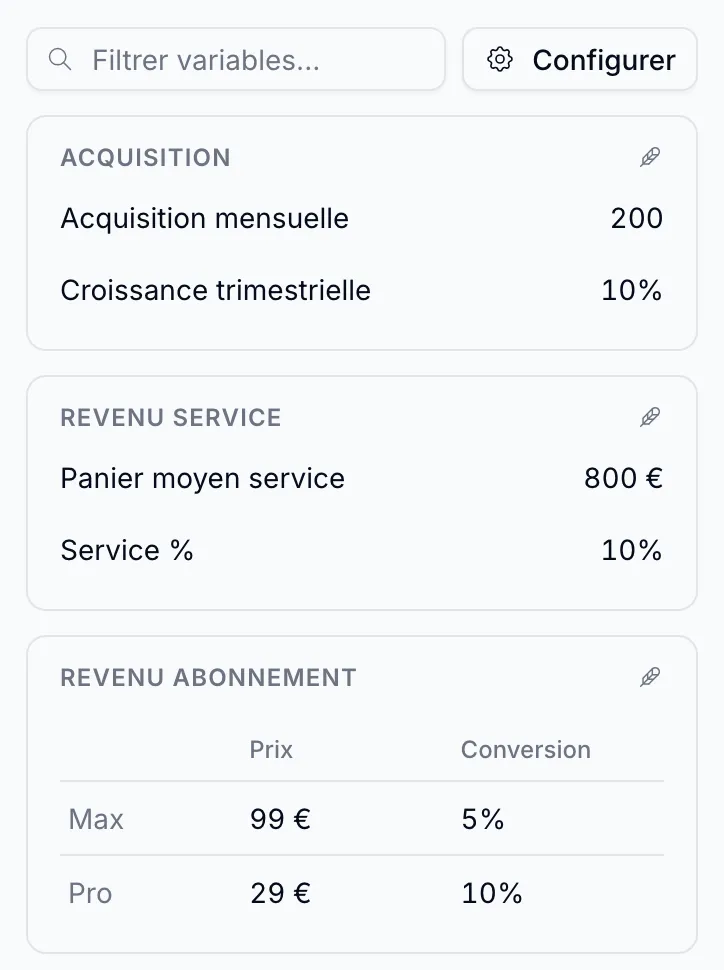
In BeretPlan, every assumption becomes a named variable: change the price, and the forecast, the income statement and the dashboards follow.
AI gives you assumptions. BeretPlan turns them into a plan.
Paste your numbers into BeretPlan: every assumption becomes a named variable, and the forecast, the income statement and the dashboards recalculate with every adjustment.