Your team has a budget. You deserve better than a shared spreadsheet tab.
You run your team's budget, not the company's accounts. BeretPlan gives you what the shared tab never will: what's left per project, variances you see the moment they appear, and a dashboard ready for tomorrow morning's exec meeting.
Free, no credit card required.
Accountable for the budget, with no way to see it
You're not a finance person, and that's not the issue. The issue is that the tool you were handed (one tab in finance's workbook) answers none of your questions.
Thursday, 6 p.m. Exec meeting tomorrow morning. Three versions of the workbook open, a nagging doubt on the contractors line, an email off to finance (reply hoped for by Friday). That's not a competence problem: it's a tooling problem.
The budget lives in a tab
A workbook shared with finance, filters that vanish, formulas nobody dares touch anymore. The up-to-date version? Whoever saved last.
Nobody knows what's left
The budget says one thing, the actual spend shows another, and nobody reconciles the two. Trade-offs get made on gut feel, and year-end comes down to a pocket calculator.
Monthly reporting is a chore
Every month you re-key the same numbers into a slide leadership skims. Time-consuming, error-prone, and it doesn't help you decide anything.
What's been spent, what's left, and where it's slipping
A budget structured the way you actually work (by project, by category, by month) and put up against reality with no parallel re-keying.
Actuals entered in minutes, variances in plain sight
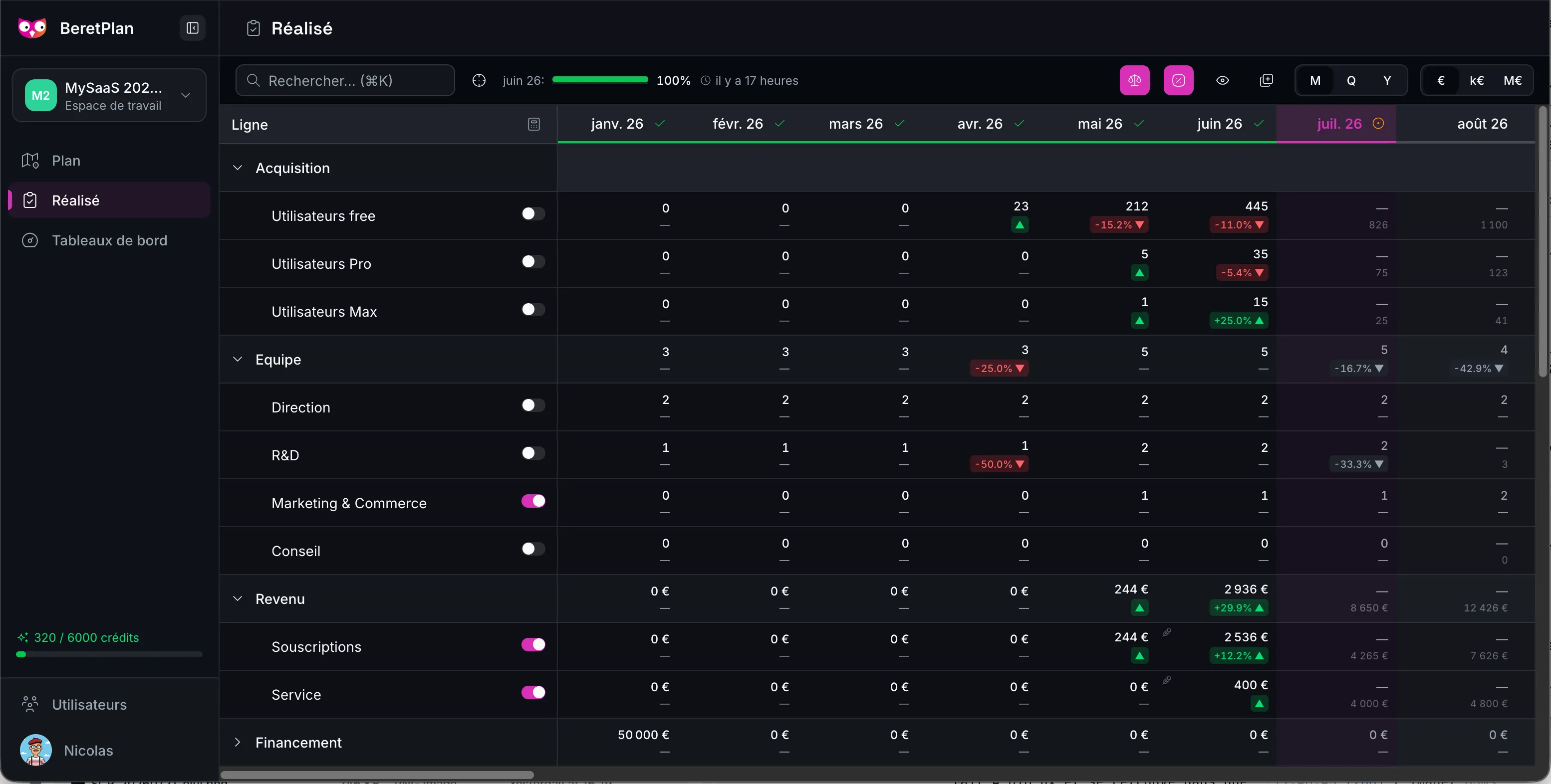
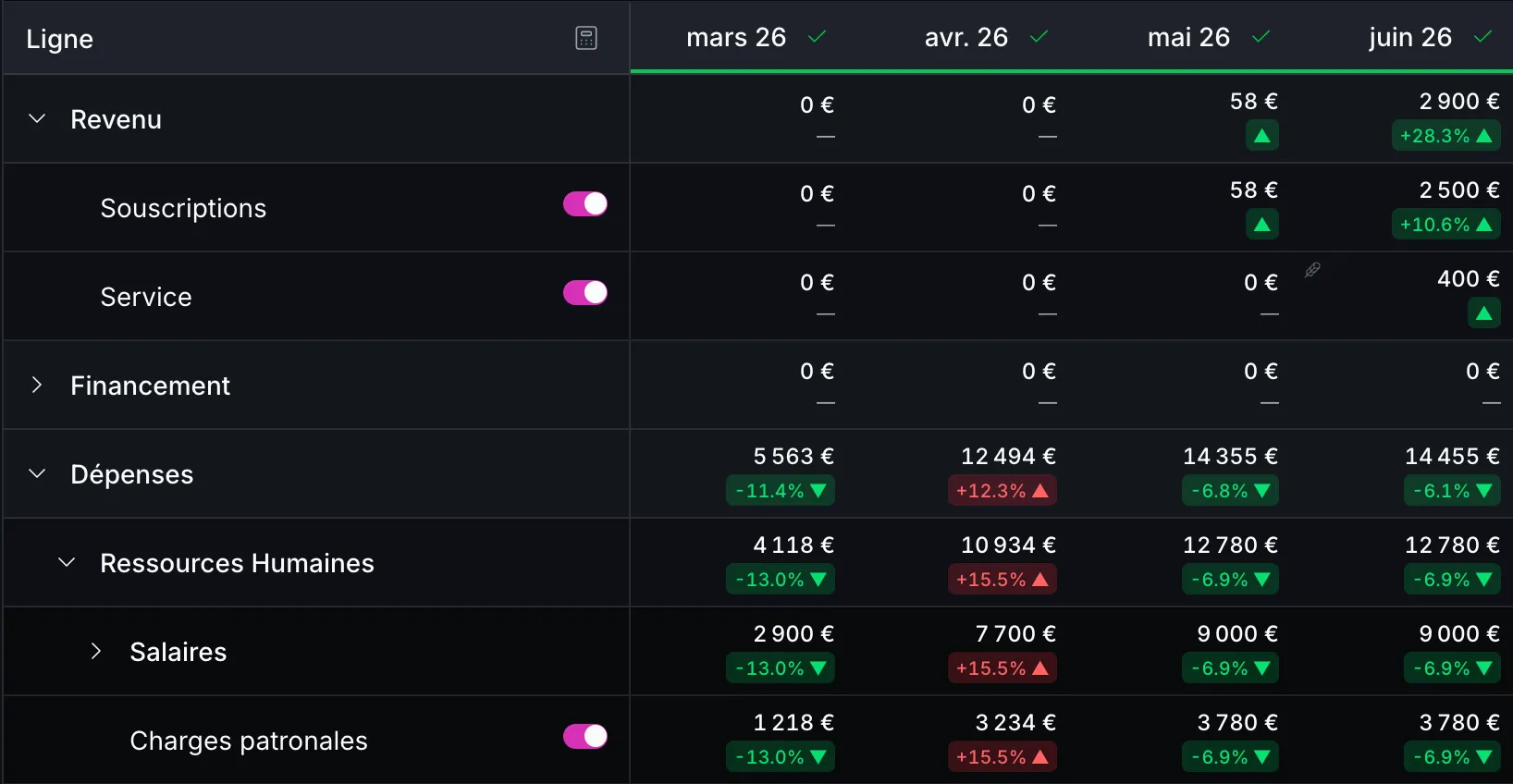
Structure your budget into categories and sub-categories that speak your language (campaigns, contractors, licences, travel), then enter your actuals in a grid built for speed, with a month-by-month focus mode. The variance shows up instantly, colour-coded by real impact: an expense that overshoots turns red, even if the curve goes up.
- Hierarchical lines that mirror your projects, not the chart of accounts
- A fast entry grid with focus mode: the monthly ritual, done and dusted
- Actuals vs forecast line by line: you see what's left, with nothing to recalculate
You write, leadership reads
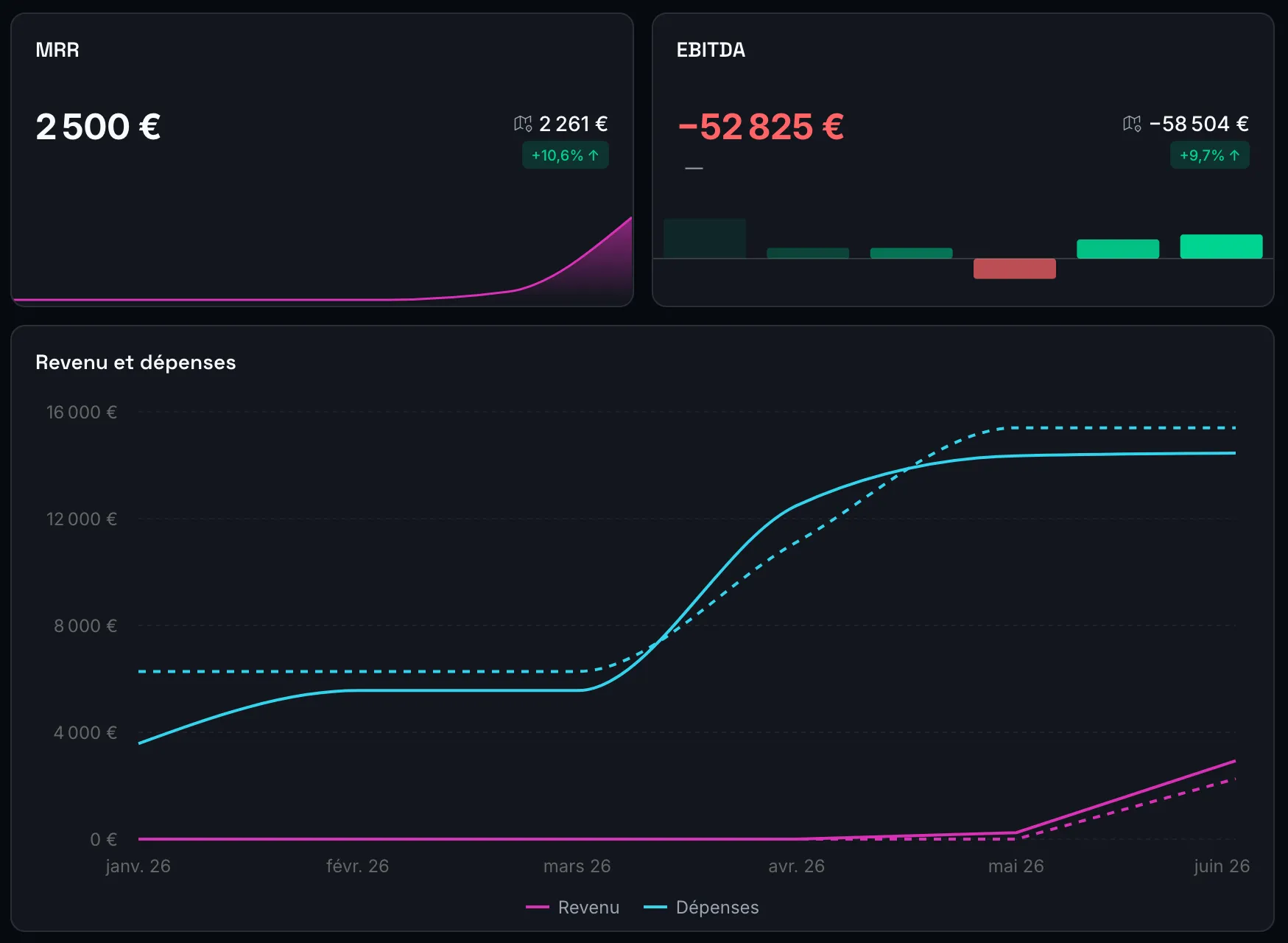
The promise: you keep write access, leadership views without any way to overwrite a line. Today it lives on a shared screen: dashboards are generated straight from your budget, and Monday's exec meeting reads the same numbers you do, with no slide prepared the night before.
- Dashboards you tailor to each audience: your team, your boss, the executive committee
- Reports always aligned with the budget: change one assumption and everything follows
- Soon Admin, write and read-only roles, when the paid plans open
- Soon A free read-only link to share with your leadership
Trade-offs down to the euro, not on gut feel
Every assumption in your budget is a named variable. Change it, everything recalculates, and you know straight away whether September's hire still fits.
Named variables
A contractor's day rate changes? Update it once and every line that uses it recalculates. No cell left behind in a corner of the tab.
Dates on every line
A contract that starts in March starts in March in the budget, and stops when it stops. Each line has its own dates, no hand-rolled conditional formulas.
Formulas that don't break
No #REF!, no line overwritten by accident. Formulas display in plain, readable language: your leadership understands the calculation without calling you.
Sub-plans: one budget per team, consolidated at company level
The building block we're working on for you: each team will run its budget in its own space, and the company will see the overall consolidation. Marketing, tech and ops will stop reconciling their numbers by email.
Let's be straight with you: this hasn't shipped yet. In the meantime, build the budget for your own scope and present it to your leadership: consolidation will plug right into it.

What sub-plans will bring
- A self-contained budget per team or business unit, with its own access rights
- Automatic consolidation at company level
- Cross-team trade-offs made on the same numbers, at the same time
The questions managers actually ask us
Can my leadership view the budget without the risk of changing it?
Today, they view it with you: the Free plan is single-user, so you present the budget and dashboards in the meeting or over a shared screen (same numbers for everyone, no risk of a line being overwritten). When the paid plans open, your leadership will get its own read-only access (admin, write and read-only roles); a free read-only link is coming soon. The promise stands: they read, you write.
Does BeretPlan replace the finance team's tools?
No, and that's not the point. Accounting stays with finance. BeretPlan runs your scope: your team's forecast, the actuals you enter, the variances and the dashboards. What disappears is the shared spreadsheet tab (time-consuming and error-prone), not your accountant.
How long does it take to set up my team's budget?
Allow one afternoon, not a week. Describe what you need to the AI assistant, it structures the budget, you adjust your numbers, and the dashboards generate themselves. The goal: a complete budget in under 2 hours. The Free plan is free, no credit card required. Industry templates, built from real use cases, arrive this summer.

Give the shared tab back to finance.
Build your team's budget today: your projects, your numbers, and variances you see before they turn into meetings.
Free, no credit card required