

Skip to content
Business plan guide

Which business model fits your sector?

Five ways of making money, five forecasts that look nothing alike. Before you write down a single number, make sure you're modelling the right mechanics — yours.

Updated July 2026.

A bakery business plan built like a SaaS is wrong before its first line. For each profile below: how the cash actually comes in, what the model costs, the metric it lives or dies by — and the trap most forecasts in that sector fall into.

SaaS & subscription

Revenue isn't sold — it's built.

How the cash comes in
In small recurring monthly payments — or annual plans paid upfront, which do wonders for cash flow. Each customer brings in little right away, but for a long time… if they stay.
The cost structure
Almost everything is fixed: product and sales salaries, hosting, tooling. Serving one more customer costs little — acquiring them is what costs, and acquisition is paid before the revenue arrives.
The vital metric
MRR and churn. Monthly recurring revenue tells you where you stand; the churn rate tells you whether your bucket is leaking faster than you can fill it.
The forecasting trap
Confusing signed deals with this month's revenue. MRR builds slowly: an honest SaaS forecast shows modest beginnings — and a churn rate that is never zero.

E-commerce

Cash comes in at checkout — but it went out long before.

How the cash comes in
At the order, paid immediately. Comfortable on the surface: provided you have already paid for stock, advertising and logistics before the first sale.
The cost structure
Highly variable: goods, logistics, packaging, payment fees, acquisition advertising. Your unit margin is won or lost on every one of those lines.
The vital metric
Stock turnover and working capital. Sleeping stock is frozen cash; your working capital requirement measures what growth costs you in cash terms.
The forecasting trap
Forecasting revenue without forecasting the stock that makes it possible. In e-commerce, growth drinks cash: the more you sell tomorrow, the more you pay out today.

Services & agencies

You sell time — and time can't be stored.

How the cash comes in
On invoice, after the work is delivered — and often late. Deposits help, but the gap between work done and money collected remains the rule of the game.
The cost structure
Almost entirely fixed: salaries. The team gets paid at the end of the month, billable or not — which is what makes the model so sensitive to utilisation.
The vital metric
The utilisation rate: the share of the team's time actually sold. A few percentage points separate a thriving agency from one that exhausts itself chasing the month.
The forecasting trap
Building the forecast on full weeks. Holidays, pre-sales, internal projects, time between engagements: nobody bills all their time. A plan at full occupancy is fiction.

Retail & crafts

The most readable model — and the quickest to mislead.

How the cash comes in
Every day, at the till, with no payment terms. The shortest circuit there is: the baker bakes in the morning and has the money before noon.
The cost structure
Raw materials day after day, plus a heavy fixed base: rent, salaries, energy, equipment repayments. The oven has to be paid for even on closing days.
The vital metric
The margin on materials. Flour and butter prices move, your listed price doesn't: that margin needs watching recipe by recipe, week after week.
The forecasting trap
Mistaking a full till for profitability. Daily cash masks the deadlines — the equipment loan, social contributions, seasonality. A monthly forecast puts everything back in order.

Marketplace

You don't sell: you take a commission from those who do.

How the cash comes in
As a commission on every transaction between sellers and buyers. Which means it takes a very large volume of business to generate a modest revenue.
The cost structure
The platform first, then acquisition — on both sides at once. You have to win over supply and demand, and each only shows up if the other is already there.
The vital metric
Gross merchandise volume (GMV) against your take rate. Your revenue is only a fraction of what flows through: that fraction, and its stability, make or break the model.
The forecasting trap
Confusing the volume that flows through with your revenue. A marketplace forecast is built on the commission — not on the GMV that impresses in pitch decks.
The takeaway

Five models, one single rule

Every model lives or dies on a metric the P&L doesn't always show. Your forecast should be built around it — not around the table your bank is used to seeing.

Name your metric

MRR, stock turnover, utilisation rate, margin on materials, take rate: one of these numbers governs your survival. Name it, and make it a central variable of your plan.

Model its mechanics

Your metric doesn't live as an annual average. It builds month by month: recurring revenue ramping up, stock replenishments, a schedule filling up. Your forecast has to move at the same rhythm.

Dodge your sector's trap

Every sector has one — and it is well known. A sharp reader (banker, investor, co-founder) will look for it first in your plan. Better they find your answer waiting there.

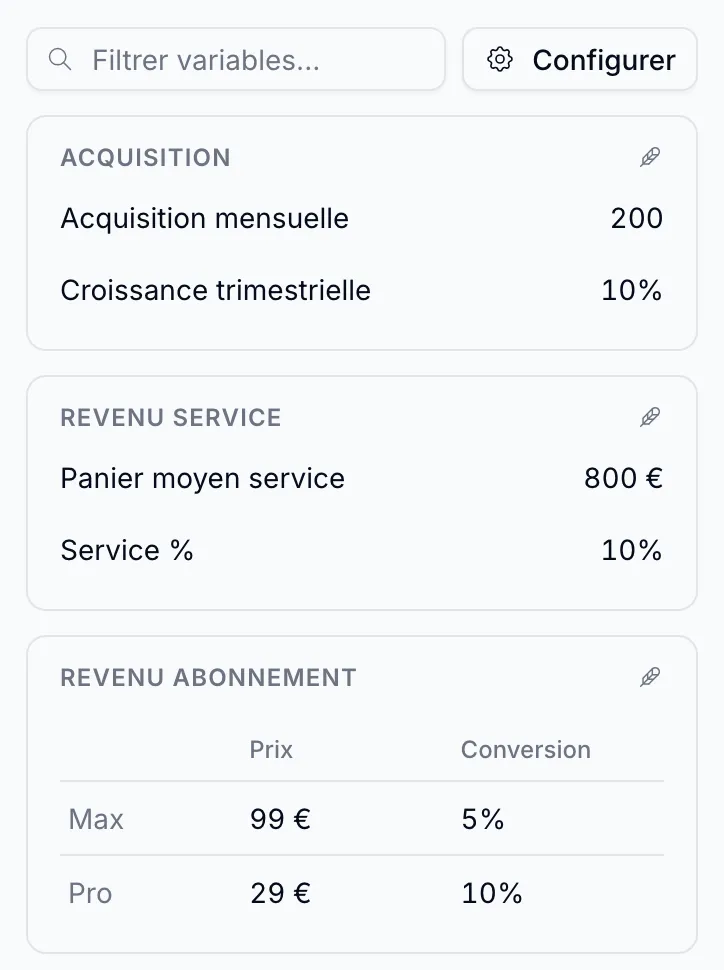
BeretPlan variables panel: grouped assumptions with their values in euros

Don't start from a blank page

This summer

BeretPlan's industry templates arrive this summer, built from real use cases: the trade's budget lines, its key variables already named, and formulas that don't break. In the meantime, the app's generic templates — SaaS, e-commerce, services… — already spare you the blank page: you adjust your numbers, the plan recalculates.

Explore templates by industry

Your sector has its model. Now put your numbers in it.

Set your assumptions as named variables and get a forecast built around the metric that actually matters.

Try for free

Free, no credit card required